Sports Physiotherapy - Foundations and Applications
Dear students,
Before you proceed, please note the following:
-
The minor consists of two modules. You can only take part in the the second module Applications, if you took part in module 1 Foundations. This is done because you cannot follow the second part (applications) without having followed the first part, which lays the foundation for the second part. In the second part, we apply knowledge from the first part in practical situations.
Module Sports Physiotherapy - Foundations (15 EC)
-
So, if you want to do 15 EC only, then the only options you have is to register for the module Sports Physiotherapy - Foundations (15 EC).
-
Module 1 Foundations (15 EC) is taught in:
-
Block 1 (semester 1 , calendar week 36-45) during this block the language spoken is English
-
Block 3 (semester 2, calendar week 6-15) during this block the language spoken is Dutch
-
Sports Physiotherapy (Foundations 15 EC & Applications 15 EC)
-
If you want to do 30 EC (e.g., Foundations 15 EC & Applications 15 EC), you should enroll in Sports Physiotherapy (30 EC) only.
- First you take the module Foundations in block 1 (semester 1 , calendar week 36-45, English spoken) or block 3 (semester 2, calendar week 6-15, Dutch spoken),
- Then you follow the module Applications in block 2 (calendar week 46-5 next year, English spoken) and block 4 calendar week 16 - 27 semester 2 - Dutch spoken).
- Please note: you always take both blocks within the same semester!
Topics
In the second part, we apply knowledge from the first part in practical situations. Please note we focus on the individual athlete and use a more qualitative case-based approach, you will learn to apply sports (injury) diagnostics from the first module to rehabilitation goals and trajectories, both on a physical and psychological level. Just like the first part, in the second part practical classes are also supported by a wide range of theory lessons such as Advanced Exercise Physiology, Sport & Performance Psychology and the role of Sport Nutrition for performance and recovery. You also learn to "zoom out" from individual level to what you can do for a sports club by collecting and analyzing performance data at the group level. Field assignments will support your development as a critical and more scholarly professional (e.g. the practitioner-scientist).
The first part covers the following topics, among others:
- Sports clinics
- Orthopedic diagnostics for sports injuries
- Sports Motion Analysis
- Performance testing of athletes
- Exercise physiology & training
- Sport & Performance Psychology (e.g., personality, motivation, confidence, mental health)
- Injury prevention project
The second part covers the following topics, among others:
- Sports clinics
- Orthopedic diagnostics & case-based training for sports injuries
- Sports Motion Analysis (Correcting and coaching of a sports motion error)
- Performance testing and monitoring of athletes
- Advanced Exercise Physiology (e.g., interpretation of cardio-pulmonary exercise tests, overtraining syndrome, recovery and cardio-respiratory health in endurance sports)
- Sport & Performance Psychology (e.g., coping with injuries, mental health in (elite) athletes and a number of commonly used psychological skills trainings)
- Applied research management
- Case study
Leerdoelen
This minor has a broad focus and supports the development of T-shaped professionals. You will deepen your knowledge and skills within a specific field, such as exercise physiology, but you will also broaden your knowledge by taking classes in sports psychology, for example. In this way, you will also learn to apply cross-disciplinary clinical reasoning and practical skills.
Types of learning
Within the minor, we have three sub-courses in which the above is reflected in three different forms of learning.
Knowledge learning (Theory Lab)
-
New theories, viewpoints
-
Integrate in existing knowledge
Skill learning (Practical Lab)
-
Devellop new skills & improve existing skills
-
Contextual understanding
Attitudinal learning (Field Lab)
-
Deeper understanding skills, goals, values and drives
-
Who are you as a professional?
The main learning objectives of the first part "Foundations" are:
-
describe and explain some common fundamentals of sport biomechanics, exercise physiology, and sport & performance psychology';
-
perform sports related orthopedic diagnostics tests skilled and routinely;
-
perform selected sports performance tests accurately, safely and validly;
-
analyze performance demands and athletic requirements for a sport;
-
perform (yourself) and analyze some selected strength and conditioning exercises from a bio-mechanical perspective (applied level, not scientific).
-
carry out an injury prevention project at a sports club.
The main learning objectives of the second part "Applications" are:
-
Learn to assess and monitor both athletes' physical and mental performance and recovery:
-
able to take performance test in a case based or embedded sports science situation;
-
able to analyze cardiopulmonary exercise tests or lactate tests and prescribe endurance training guidelines for an individual athlete;
-
able to recognize mental health and recovery related issues in elite athletes.
-
-
Learn to create physical and mental training plans for rehabilitation of common sports injuries and sport performance:
-
able to apply selected case based physical training strategies (clinical vignettes);
-
ably to apply selected sport & performance psychological skills.
-
-
Learn to analyze collected data from group-level physical and mental performance tests from an embedded scientific point of view.
Ingangseisen
- Student must have a background in Physiotherapy or Exercise therapy.
- Students must have followed module 1 Foundations for Sport Physiotherapy.
- Students must meet the minimum requirement for study points and have received permission from their own school to attend the minor.
- Final check and approval by the coordinator is mandatory for registration.
Literatuur
-
Clinical Sports Medicine 5th Edition (Peter Bruckner, Ben Clarsen, Ann Cools, Kay Crossley, Mark Hutchinson, Paul Mc Crory Roald Bahr and Karim Khan) This book is available digitally through our library.
Other books will be announced at the start of the module.
Rooster
-
Classes are from Monday to Friday.
-
The timetable per week can differ.
-
Field assignments are part of this module, which may involve going to a client/ sport association outside working hours (Mon-Fri).
Contact time:
-
Roughly 10-15 hours a week
-
If you have any questions, please send an email at f.h.de.haan@hva.nl or t.ronteltap@hva.nl
Toetsing
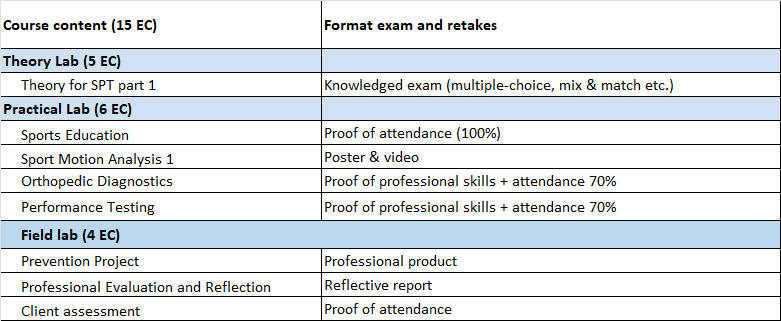
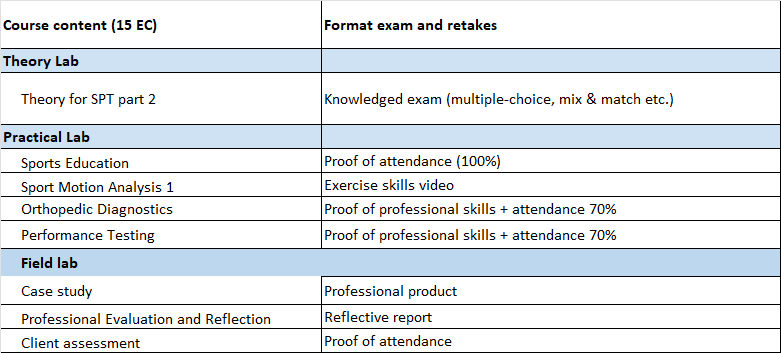
Aanvullende informatie
Costs: There are no additional costs for this module.
Please note:
- From September till January (semester 1) the official language of instruction is English.
- From February till June (semester 2) the official language is Dutch.
- Please note however that during the period February till June (semester 2) all materials (e.g., PowerPoints, lesson descriptions) and the knowledge exams are in English. We do not have a 1-1 translations to Dutch for all our materials and the knowledge exams to avoid errors due to synchronization problems.
Questions about the minor?
Contact: Ferdinand de Haan, f.h.de.haan@hva.nl or Ted Ronteltap, t.ronteltap@hva.nl
Questions about the Kies op Maat procedure?
Contact Niermela Chote-sobha, n.chote-sobha@hva.nl